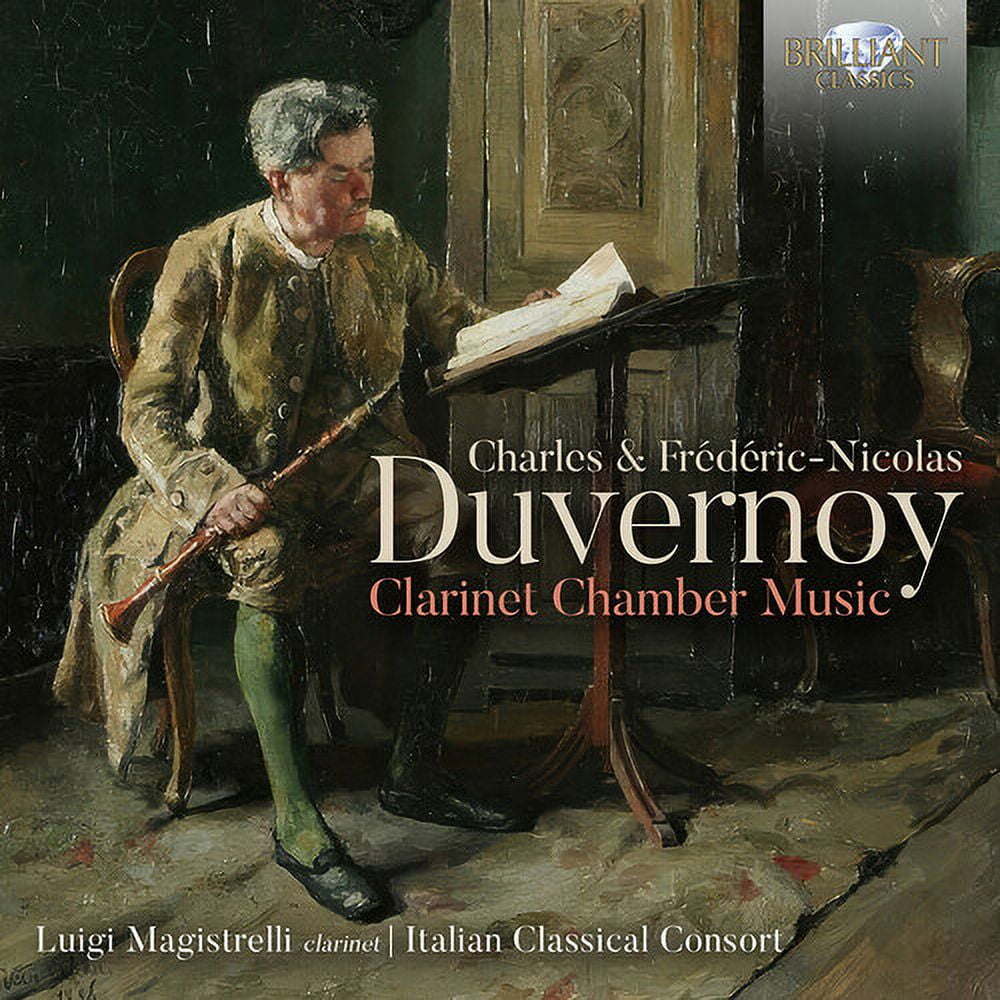
Luigi Magistrelli - C. Duvernoy & F.N. Duvernoy: Clarinet Chamber Music - Music & Performance - CD
Product details
| Management number | 255294543 | Release Date | 2026/11/21 | List Price | US$5.20 | Model Number | 255294543 | ||
|---|---|---|---|---|---|---|---|---|---|
| Category | |||||||||
There is scarce information available on Charles Duvernoy - not to be confused with Jean Baptiste Duvernoy (1802-1880), a French composer and pianist of the later romantic period, author of many studies and didactical works for piano. Charles was born in Montbéliard, France, and began clarinet studies in Strasbourg while playing in a military band. In 1790 he moved to Paris where he improved his playing - first as a member of the National Guard Band along with his brother, hornist Frédéric-Nicolas, and then achieving the posts of principal clarinet with the orchestra of the Monsieur Theatre and then the Feydeau Theatre of Saint-Germain, a position he held until 1824. He was also a professor at the Conservatory of Paris from 1800-02 and from 1808-16. The Quartet No.1 is an unpretentious but enjoyable composition with well-conceived themes in all three movements and strong connections to the classical Viennese period. The 3 Themes and Variations employ simple themes with an introduction (in a minor key for No.1 and 2) before developing them in five variations (No.1 & 2) and three variations (No.3). The two Airs varies (chosen from the 6 Airs varies) were also conceived in theme and variations form. The style is purely classical and resembles other Airs (or Sonatas) written by French composers such as Lefevre, Devienne or Buteaux. Originally written for C clarinet and bass, this recording uses a B flat clarinet and basset horn for a better timbral match. For authentic colour, the clarinet is an early, original Lefevre six-key boxwood instrument from the early 19th century. Frédéric-Nicolas's Trio No.1 is the work of a virtuoso hornist. In 1788 he went to Paris and joined the Orchestre de la Comédie italienne. Two years later he became hornist of the Orchestre de la Guarde National and later was a professor at the Paris Conservatory, where he served until 1815. He also played in the Orchestre de l'Opéra de Paris from 1796-1817. He left a great number of horn pieces including 12 horn concertos, trios, nocturnes, quintets, etc. The Trio recorded here features a well-developed first movement and a second movement consisting of a short theme with four carefree variations ending in a brilliant coda. The horn is substituted with the more velvety, nasal colour of the basset horn, creating a new, interesting timbral combination.
- CLARINET CHAMBER MUSIC
- Music & Performance
- Brilliant Classics
| Performer | Luigi Magistrelli |
|---|---|
| Music genre | Classical |
| Music subgenre | Chamber Music |
| Media format | CD |
| Is collectible | N |
| Has parental advisory label | N |
| Number of discs | 1 |
| Series title | Music & Performance |
| Track listing | Coming Soon! |
| Record label | Brilliant Classics |
| Composer | C. Duvernoy & F.N. Duvernoy |
| Track name | Quartet No. 1: I. Allegro Vivace, Quartet No. 1: II. Lento, Quartet No. 1: III. Valzer, Theme and Variations No. 1, Theme and Variations No. 2, Theme and Variations No. 3, Two Airs Varies: I. Airs de Tarare, Two Airs Varies: II. Allegretto, Trio No. 1: I, Trio No. 1: II |
| Digital audio file format | CD |
| Music media format | CD |
Bestseller ranking
Classical Composers
Correction of product information
If you notice any omissions or errors in the product information on this page, please use the correction request form below.
Correction Request Form